Friday, December 26, 2014

Day 8 – As Far South as We Can Go

December 25, 2014

Today our expedition took us as far south as we could go; farther, in fact, than any other ship this season!  To get there, we sailed through the very narrow Lemaire Channel.  Judging by the scenery on the horizon, I could not believe that we would even fit through the channel, but as we approached it, a gap appeared seemingly out of nowhere. 

Understanding scale is one of many keys to navigating this area.  Mountain ranges here are so high and the sea so expansive, it is challenging to comprehend just how massive these landforms are.  

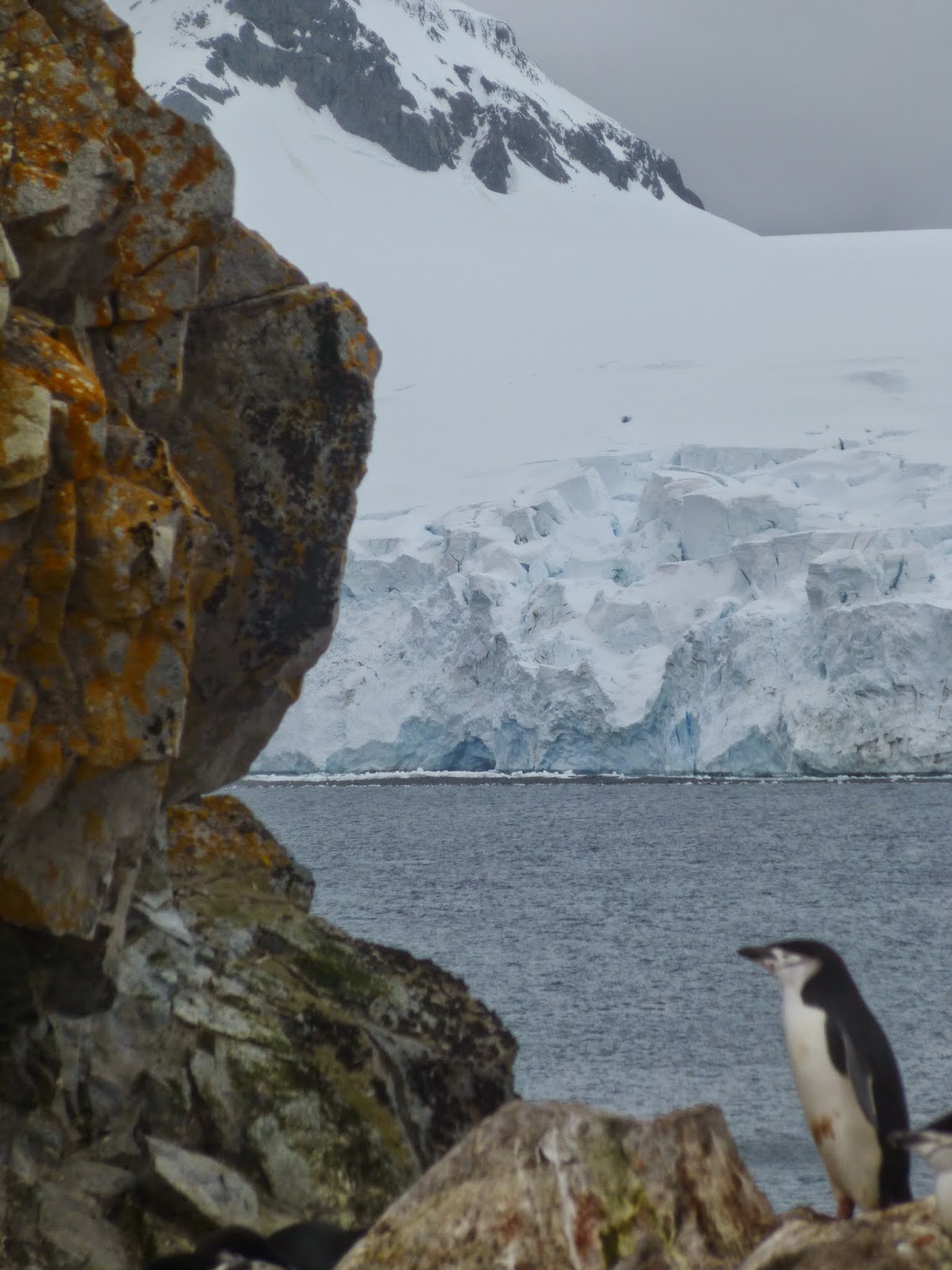
To help us make images that adequately represent what we are witnessing visually, we have learned a few tricks from the photographers involving the use of scale.  When showing how high a mountain is, we have tried to include the ship in the picture because seeing the relative size (the ship to the mountain) helps paint a picture for people who have never seen a place to get a sense of what it was like.  Often, we have used the kayaks, zodiacs, penguins, or rocks in images as another way of showing scale.  It also helps to use the right photographic lenses to highlight the foreground or background depending on the image being created.

The practical application of scaling gave me a conceptual understanding of the intersection of math and geography.  Estimating length (length of hiking trails, distance between objects, or, in our case, the width of the opening to a channel) and height (incline to a mountain peak, distance to a lookout, height of an iceberg) are skills that explorers use to better understand their environment.  Out in the wilderness there are no mile markers, no buildings, and no standard measurement tools.  Figuring out ways to help our students think flexibly and spatially about our environment will give them strategic skills that they can apply to any situation around them.  In addition to the technical skill of surveying an area, it also has implications for art, such as photography, to help students incorporate scale to make their images come alive for viewers.

After traversing the channel, we paused for a visit to another penguin colony on Booth Island.  Surrounded by mountains and ocean, the Gentoo and Adelie penguins were nesting on lookout points.  We were excited to see that one of the Gentoos was warming two fuzzy grey babies!  As these little chicks grow, they will need a lot of food as well as protection from the predatory skuas that are hovering above in search of a meal.
 
In addition to the Gentoo babies we were intrigued by the story of the Adelie penguins.  As the climate changes and Antarctica warms up (it is the fastest warming continent on the planet), these polar birds are being pushed to the mainland of the continent.  As a result, they will likely become extinct in the peninsular area that we are currently exploring.  Incidentally, the mainland of Antarctica is also where the massive Emperor penguins live, which, unfortunately, means that we will not be able to visit them on this expedition.

We departed Booth and took off in search of sea ice in the Penola Strait.  Standing on the bow of the ship, we cheered as we plowed our way through the icebergs bursting them into smaller pieces of ice.  In the distance a large mountain range formed the background for tabular icebergs that were likely a mile or longer in length.  Tides gently lifted the sea of ice rippling through the entire strait and gently rocked our ship.

Along the way, we caught glimpses of Weddell and Crabeater seals lounging on icebergs.  (The name “Crabeater” is actually misleading; these seals don’t eat crab at all!)  They snaked their torpedo-shaped heads to observe us as we passed by, curious about our intrusion into their secluded world. 

We celebrated our journey to the furthest southern region of this voyage with a toast to the great Antarctic explorer Ernest Shackleton and his crew. 


Our trip South had officially ended and we began the arduous journey back home.

As close to cuddling Gentoo penguins as one can get

Adelie penguin

Leopard seal

Crabeater seals


Wednesday, December 24, 2014

Day 7 – Polar Plunge!

Anticipation built as we waited for the call.

“Good Afternoon, Everybody; Good Afternoon.  For those of you who are going to do the Polar Plunge, please make your way to the mudroom and we will begin the event in just a few minutes…”

The moment had arrived.  We nervously left our cabin and proceeded to the mudroom where we encountered quite a party!  Dance music was blaring and people young-in-age and young-at-heart were dancing in swimsuits and bathrobes waiting to be the next to plunge into the icy depths of the Southern Ocean.

Air Temperature:  43 degrees Farenheit

Water Temperature: 33 degrees Farenheit

The four of us – Nina, Jenn, Mariam, and I – locked arms, climbed up to the jump spot, squinted our eyes and leapt into the abyss.

I plunged into the darkness and immediately felt the instinct to find my way back up to the top, the frigid water urging me along the way, showing me that I did not belong there.  I burst through the surface in a spray of salty water and swam toward our saviors.  Someone grabbed my arm and helped me onto the platform back up out of the water.  It’s amazing what the cold does to your neurological system. All the way off the platform, into the zodiac, and up the stairs back to the mudroom my lips trembled and my voice spasmed with sounds I didn’t think I was capable of making. 

We rushed into the mudroom where we were handed towels and a cup of peppermint hot chocolate.  My friends and I looked at each other and laughed. 

We did it!

On the eve of my 35th birthday, the plunge serves as a perfect metaphor for my life.  Symbolically, I see it as an end to old ways of thinking and being – a cleansing, so to speak, and a choice to move in new directions, to advance to new horizons.  The ocean –cold, dark and intimidating to many – is, to me, invigorating and inspiring.  Like the ocean continues to move and refresh itself, we can always be better than we were before.  We can always choose new paths, and with persistence we can always get to where we want to go.

That moment, to me, was the celebration of my personal new year.

The festivities continued with an exquisite dinner prepared by our dedicated kitchen staff and servers.  We were treated to a Swedish Smorgasboard filled with an array of fresh fish, meats, and vegetables complete with a bottle of Chilean Carmenere, courtesy of our new friend, Mary, from Australia. 

The conversation was as wonderful as the meal, and complemented with a few humpback whale sightings out the window on our cruise to the next destination.  I tried making a few images of them, but have learned quickly that sea creatures are elusive while swimming. 

Our nightly ritual of retreating to the library of the ship for journaling and catching up with our blogs, was filled with quiet reflection, some laughter and commentary as we looked through our pictures from the day, and, as always, the majestic view of ocean, mountains, snow, and ice...and a few orcas on the way.

This expedition, this “plunge,” has forever impressed itself on my soul.  It has been an amazing journey—as much a personal quest for knowledge and worldly understanding as a professional endeavor and a way to make these deep concepts meaningful and inspirational for my students.  We cannot teach what we don’t know, right?  Well, now I feel like I actually do know. 

I am relishing this moment and the next few days of this expedition and I will certainly enjoy bringing this global awareness and interdisciplinary learning to my schools back home.  A voyage such as this is reserved for the privileged few and I intend to bring this voyage home to the many young people who are learning in our schools right now.  

It is exciting to wonder how many young people will be inspired to become global travelers, citizen scientists, environmental stewards, travel writers, or fellow educators as a result of the curriculum and instruction we educators will bring back to our classrooms from this experience.

Into the open waters we shall venture to bring this experience to life for our students!

Kayaking


More Gentoo Penguins

Orcas (killer whales) swimming by our ship


Day 6 – Glaciers, Icebergs, and…More Penguins!

December 23, 2014

Remember my commentary about how time passes in Antarctica?  Well today it must have warped because somehow we managed to pack more activities and learning into a 24 hour cycle than I thought humanly possible!

Our day began bright and early with breakfast at 7:30 followed by our first activity – a zodiac tour around Cierva Cove.  We made our way through the pristine water, the crisp air blowing in our faces, our zodiacs plunging through the “bergie bits” scattered throughout the water.  Their parents, the larger icebergs, towered overhead all around the cove, radiant in the morning sun.  Across the way, we visited a grandfather iceberg patterned with deep blues and greens.  

Icebergs and glaciers contain compacted water that is so tightly compressed in many places it squeezes all air out of the water.  This causes our eyes to perceive a blue hue, when looking at the snow and ice.  Cierva Cove was full of massive snow and ice structures streaked with bright blue tint.  Listening closely all around us we could hear the snap, crackle, and pop of air being compressed out of ice:  a reminder that although they appear frozen and immobile, these mammoth structures are constantly flowing and changing.

About halfway through our tour we were approached by another Lindblad zodiac flying a flag that read “Hot Choco.”  We were delighted to receive a cup of hot chocolate from these fine gentlemen and took a few moments to indulge in the scenery and the warmth of our beverage. 

We continued on and discovered a leopard seal basking on an iceberg.  He eyed us lazily and then yawned, displaying a large mouthful of tricuspid teeth—perfect for munching on krill, fish, or (gasp!) the occasional penguin (hey, everybody’s got to eat something...it’s all part of the ecosystem).

Trading the liquid mirror of Cierva Cove for the much choppier waters of the Enterprise Islands, we again took the zodiacs out for a cruise around the area.  There, we saw the ruins of some old shipwrecks and more glaciers, mountains, and icebergs.  This ride was much colder with frigid seaspray in our faces; nevertheless, it was a small price to pay for the memorable experience.

During lunch we began our journey toward Danco Island.  A few of us ate in the Observation Lounge atop the ship and enjoyed a stunning view of the ride.   Snow-covered mountains in the distance created the perfect Antarctic backdrop for the scenes in the water: whitecaps blowing against icebergs, occasionally causing them to flip on their sides, and hitch-hiking penguins taking a ride on the icebergs.

En route to Danco Island we had several staff give presentations to further enhance our experience.  We learned more details about glaciers and ice as well as leopard seals.  Our National Geographic photographer also showed us a presentation of her photography work in Alaska and described how she uses her photography to tell stories of the complexities of oil drilling and the Alyeska Pipeline.

After this, we were pleasantly surprised to hear that weather conditions were perfect for a late night hike up to a large Gentoo penguin colony in Danco Island.  We donned our gear and took a 9:45 p.m. zodiac to the shore where we proceeded to hike nearly 800 feet up a steep incline to observe the Gentoos. 

Similar to the Chinstrap colony we saw yesterday, Gentoos were also nesting.  These particular Gentoos seemed a little more feisty than the Chinstraps (even though I hear they tend to have a calmer disposition than Chinstraps), and I laughed to myself as I watched various troublemakers sneak around trying to pick rocks from others' nests.  Security was pretty tight and it didn’t take long for nest-defending Gentoos to peck at, and even knock over, the would-be burglars. Defeated, but still resilient, the pests would pick themselves up, dust themselves off and carry on wandering from home to home looking for goodies.

This colony also had a very defined penguin highway between the water below and the nests high above. I sat silently watching lines of penguins with clean white chests, freshly washed by days of swimming in the sea, make the steep climb to their partners and their eggs.  The birds coming down from the nests, their chests dirty from a week of sitting on eggs, looked eager to jump into the water and feast on the krill buffet their partners had recently left behind.

The penguins made going down the steep incline look easy.  Taking a few lessons from the penguins, we, too, retreated down the peak using a combination of walking, hopping, and sliding.  I relived the childhood exhilaration of sliding down the steep hill right on my snowpants with a snow-covered mountain view and a midnight sun glistening on the water below. 

It was the perfect end to the perfect day!

Halfway through the climb at Danco Island - the time is around 10:00 p.m.

Gentoo Penguin at Danco Island

Gentoo Penguins at Danco Island - Trekking up the penguin highway

Ice Bridge at Cierva Cove

Monday, December 22, 2014

Day 5 - Penguins!

“Penguins!”

The guests all rushed to the bow of the ship just in time to watch groups of penguins swimming in the cerulean waters next to us.  Everywhere we looked we spotted their little tuxedos hopping through the water in search of krill or other sustenance that would fill their bellies and prepare them to go back to their nests and take over egg incubation duty.

We anchored near Half Moon Island around noon today.  Just before lunch we had our mandatory shore briefing in which we learned about all of the precautions we must take before setting foot on the continent.  To ensure that we would not accidentally introduce any invasive or non-native species to the ecosystem by way of our boots, outerwear, or backpacks, we would have to disinfect our gear before boarding the zodiacs (motorized inflatable boats used to taxi us to and from the ship). 

Giddy with anticipation, Jenn, Mariam, Nina (our Grosvenor Teacher Fellow program manager), and I rushed to our rooms donning layer upon layer of artic winter wear.  For our first landing we would have the option of taking a four mile hike up to a penguin colony or the shorter route of less than a mile directly to the colony.  They opted for the hike, and I chose to spend my entire time watching penguins.  We disinfected our gear, boarded the zodiacs, and we were off!

Half Moon Island is home to a large chinstrap penguin colony.  The name gives away their unmistakable feature – a thin black line that runs side to side across their faces below their beaks.  One look and I was hooked on these little guys. 

Right now penguins are laying eggs and hatching chicks.  I sat for hours watching groups of penguins sitting on their eggs, building nests and rotating their eggs, courting each other, warning each other of approaching predators (the skua is  always hunting for penguin eggs), and playing on the penguin highways on this hill.

Penguins are monogamous birds as it takes two to raise their chicks.  Males court females by attracting their attention through dance and flamboyant pursuit.  Females select males carefully based on the male’s ability to help build a safe and clean nest for their chicks.  I recorded some great footage of a male bringing a female various rocks – one at a time – while the female sat on the egg, tucking the rocks around her to keep their egg safe and warm.  Often, the penguins would throw their heads back and let out loud calls when one of them saw a predator, to alert the colony to be ready to defend their eggs should a skua decide to dive into the colony.

While their partner is sitting on the eggs, the other partner goes out to sea to feast on krill and fish.  Their bellies full, they come back and trade places, letting the partner go out to sea to feast.  This continues until the chicks hatch and grow big enough to be on their own, at which time the parents disappear back at sea and do not return until breeding season starts again.

The experience of observing penguins in their natural environment was captivating.  Everywhere I looked, I saw penguins coming and going, often hopping through the snow or sliding along their bellies to get where they wanted to go.  We had been instructed to maintain at least a 15 foot distance from them and to stay out of their way as they meandered around.  We were not allowed to interfere in any possible way with their natural behavior.  As I sat very still, I watched them walk right by me en route to their mates or to the penguin highway.

The penguin highway is the path that is left when penguins continue on the same course day in and day out.  Highways were all over coming up the hill from the beach toward the various sites of colonies and nests.  It was really fun to watch penguins slide down the hills on their bellies toward the sea.

After our visit to the penguin colony, we attended the Captain’s Reception and then dinner celebrating our official first landing in Antarctica.  There we learned that the weather was permitting us to enter into the caldera of Deception Island. 

Deception Island is actually an active sunken volcano.  It is shaped like a “c” with an opening about a mile across.  The ring of mountains reaches upwards of 1,500 feet and the interior is about six miles across.  The floor is so deep we were able to bring the ship very close to the interior shore where we watched penguins roam about an abandoned whaling station. 

Having spent a little time at Deception Island, we retreated and are on our way to our next destination.  Weather-permitting, we might get to kayak tomorrow.  Everything depends on the weather here since it is very unpredictable. 

Since I have been burning the candle at both ends these days, I am off to get a good night’s sleep so I can be up bright and early again tomorrow morning.


‘Til then!


Sunday, December 21, 2014

Day 4 - A Peaceful Summer Solstice

It could be said that in Antarctica, time does not exist.  Weather patterns, life cycles, sunrise/sunset, those exist, yes; but actual time as we know it – the passage of seconds, minutes, hours, days, weeks, months, years – feels suspended, trapped in the ice of the frozen landscape.  In fact, standard time, literally, does not exist here because in Antarctica there is no officially recognized time zone.  The time zone by which we are operating is the same as they use in our city of departure, Ushuaia, Argentina.  Same goes for other ships traveling to this area – they recognize the time zone of the location from which they depart. 

Having spent the past 28 hours sailing in the open water, the gentle waves of the “Drake Lake” lulling us into perpetual drowsiness (we got incredibly lucky on this passage),  and the fact that the sun still has not completely set by now (it is 11:30 p.m.), I am losing track of time.    In some respects, this is the most liberating experience thus far. Removing the constraints of linear time has allowed for me to absorb more information, have more meaningful conversations, and enjoy this experience in a profound way.
 
Our daily agendas are printed basically on a daily basis.  We have general items that are standard – meals and time slots for various activities – but we are not on a specific schedule.  This allows us the flexibility to adjust to whatever amazing experiences might appear out here in the southern ocean.  For now, we are on track to cross 60° South Latitude – marking our arrival into the area of Antarctica – sometime within the next hour or so.  Tomorrow morning we are anticipating a visit to a chinstrap penguin colony, and I am getting very excited!

Today’s agenda included an overview of the Antarctic Treaty, a lecture on krill and sustainability of resources and ecosystem conservation in Antarctica, and a refresher course on how to use our cameras to create optimum images.

Some notes on each of the topics include:
  •    If we change the language of photography, it changes the way we approach it.  Instead of saying we are “taking photos,” we could say “making images.”  This shift in language causes us to pause and thoughtfully consider how to use our cameras to create beautiful images that tell stories, versus aggressively or disconnectedly “capturing” a subject.  Photos are all about perspective and composition and can be thought of as “the art of painting with light.”
  •     Krill.  There is a lot to say about the disruptions that are happening with the krill population as a result of climate change and fishing enterprises.  Depletion in the krill population disrupts the balance in this polar ecosystem because they are the food that penguins, and other animals, eat.  Less food means fewer babies and, without the proper regulations or sustainability mindset, this could have disastrous consequences for penguin populations…to the extreme case of endangerment.
  •     Antarctica belongs to nobody and everybody all at once.  The Antarctic Treaty has defined Antarctica as a place for global peace and scientific exploration.  Policies are influenced by several Non-Governmental Organizations (NGO’s).  The Convention for the Conservation of Antarctic Living Resources was created as a part of the Antarctic Treaty, and is charged with meeting annually to discuss issues related to the continent.  The scientific committee is instrumental in conducting research and writing papers to advise this group, and support them in determining courses of action.  The end results of this range, from creating public campaigns, advising political leaders, and educating the world about how to approach our interactions with the environment through a focus on ecosystems and precaution.

Throughout the course of the day, there were constant reminders of the need for an interdisciplinary approach to educational studies.  If our young people are going to be properly prepared for a sustainable future, and to be the innovative problem-solvers the world desperately needs, we have a responsibility to help them see connections all around them.  It is an intellectual challenge to be a little out of my area of expertise (science), and I am relishing every bit of knowledge I can gain. 

I hope that you are learning a lot as well as a result of this blog!  Please post any questions you have and I can do my best to get them answered.
 
A glance at my watch tells me that it is “officially” 12:30 a.m. and so I must get some sleep.  There is still a small glow on the horizon, and our daily report tells us that the sun will be back up around 3:30 a.m.


Happy Solstice!

Relaxing for the night in the Reception area.  This was taken around 10:30 p.m.


Photos from the stern - trying to capture the sunset